

Discover how to use SLURM, the workload manager that schedules jobs, allocates computing resources, and ensures they are shared fairly and efficiently across DiRAC and other HPC facilities.
Running Jobs on HPC Systems is designed for researchers who are new to HPC or looking to build confidence using shared computing resources. You'll learn the practical skills needed to submit, monitor, and manage jobs with SLURM, helping you run your research more effectively on HPC systems.
A concise introduction to the essential skills of software development using the established C and C++ programming languages, with a particular emphasis on scientific software development, correctness, performance, and reliability. The focus is on numerical programming and problem-solving rather than on platform-specific tools.
The course is self-paced, and uses a combination of pre-recorded lectures delivered by academics at Durham University in September 2025, alongside interactive programming exercises for active learning.
The course will also run some live Q&A sessions focused on the exercises from 14 September through 25 September 2026 from 14.00 - 17.00 (UTC+0).
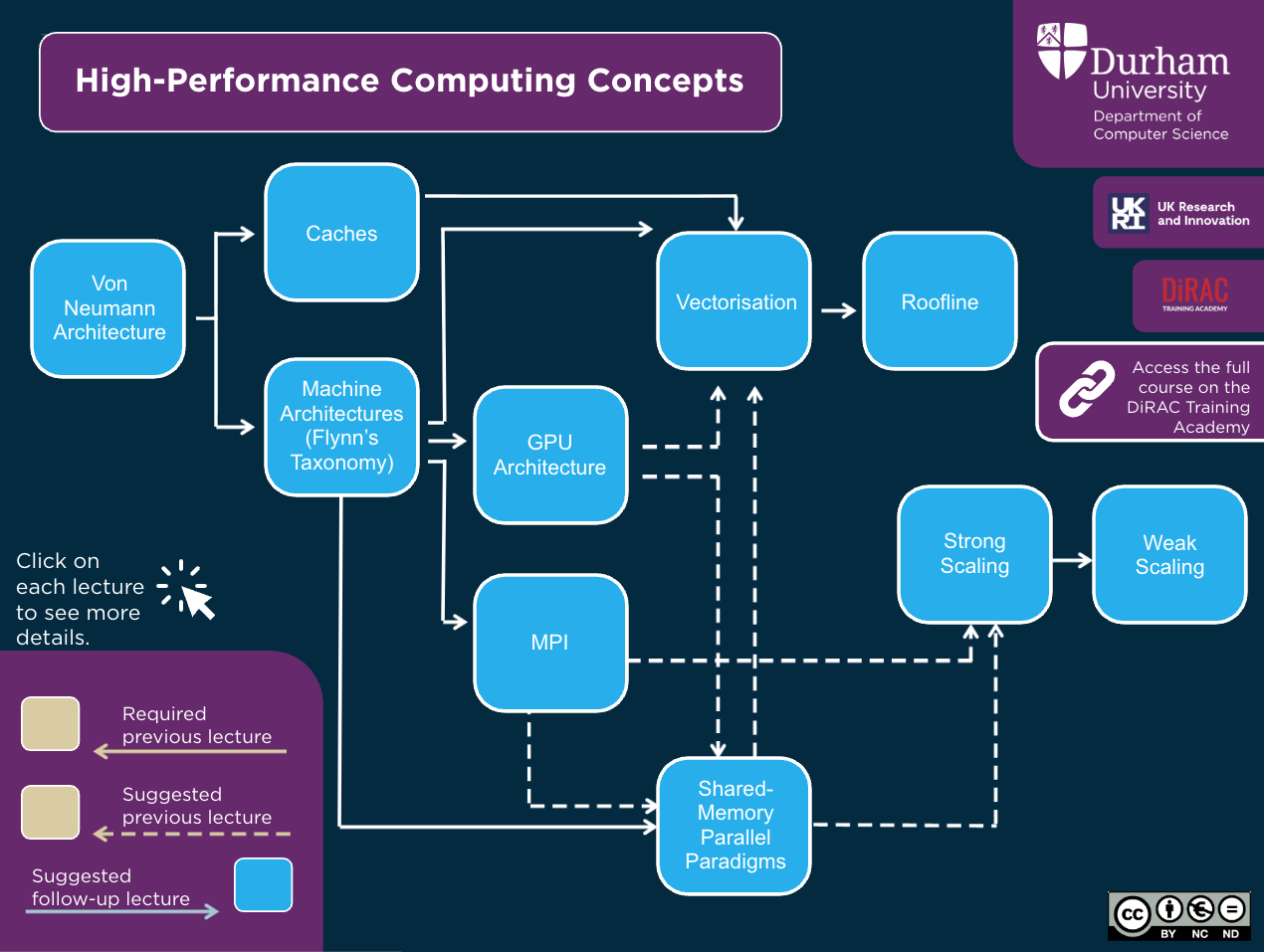
Developed by Durham University as part of the HAI-End project, HPC Concepts is designed to help participants quickly revisit essential terminology and foundational concepts, and to support workshops and practical sessions on performance analysis in High-Performance Computing (HPC).
Its flexible design allows you to build your own personalised learning pathway by choosing any topic of interest to begin your learning journey. Based on your selection, the knowledge graph will recommend prerequisite sessions to review, as well as subsequent sessions to support your continued progression.
Find out how to develop parallel applications for distributed-memory High-Performance Computing (HPC) systems.
Programming for Distributed Systems will help you understand the concepts of message-passing parallelism, including how to develop, run, and optimise MPI-based applications.
Gain practical experience with modern parallel programming techniques and learn the core principles of parallel programming, including how to combine OpenMP and MPI to create hybrid parallel applications with this course.
Directive Programming for HPC will help you develop practical skills to identify and parallelise sections of code, enabling multiple threads to execute concurrently within a shared-memory model and optimising the use of computational resources.
