

Section outline
-
-
Introduction to astrochemistry
Astrochemistry, or molecular astrophysics, is the study of molecules in space. Since their first detection in the interstellar medium in the 1930's, molecules have proven to be important probes of the physical state of many astrophysical environments relevant to the lifecycle of a galaxy. For example, the formation and destruction mechanisms of molecules provide cooling mechanisms that are necessary to explain crucial processes, such as the collapse of interstellar clouds into stars. Similarly, the chemistry involved in the formation of planets is likely responsible for the emergence of life. Beyond their importance in the formation of stellar systems, chemical processes are also deeply involved in the deaths of stars. Close to the end of their life, stars similar to our sun lose most of their material through dense winds driven by dust formation, an inherently chemical process. These outflows seed the interstellar medium with fresh elements and dust grains: the building blocks of the next generation of stars and planets. Chemistry is thus irrevocably intertwined with the physical evolution of astrophysical environments.
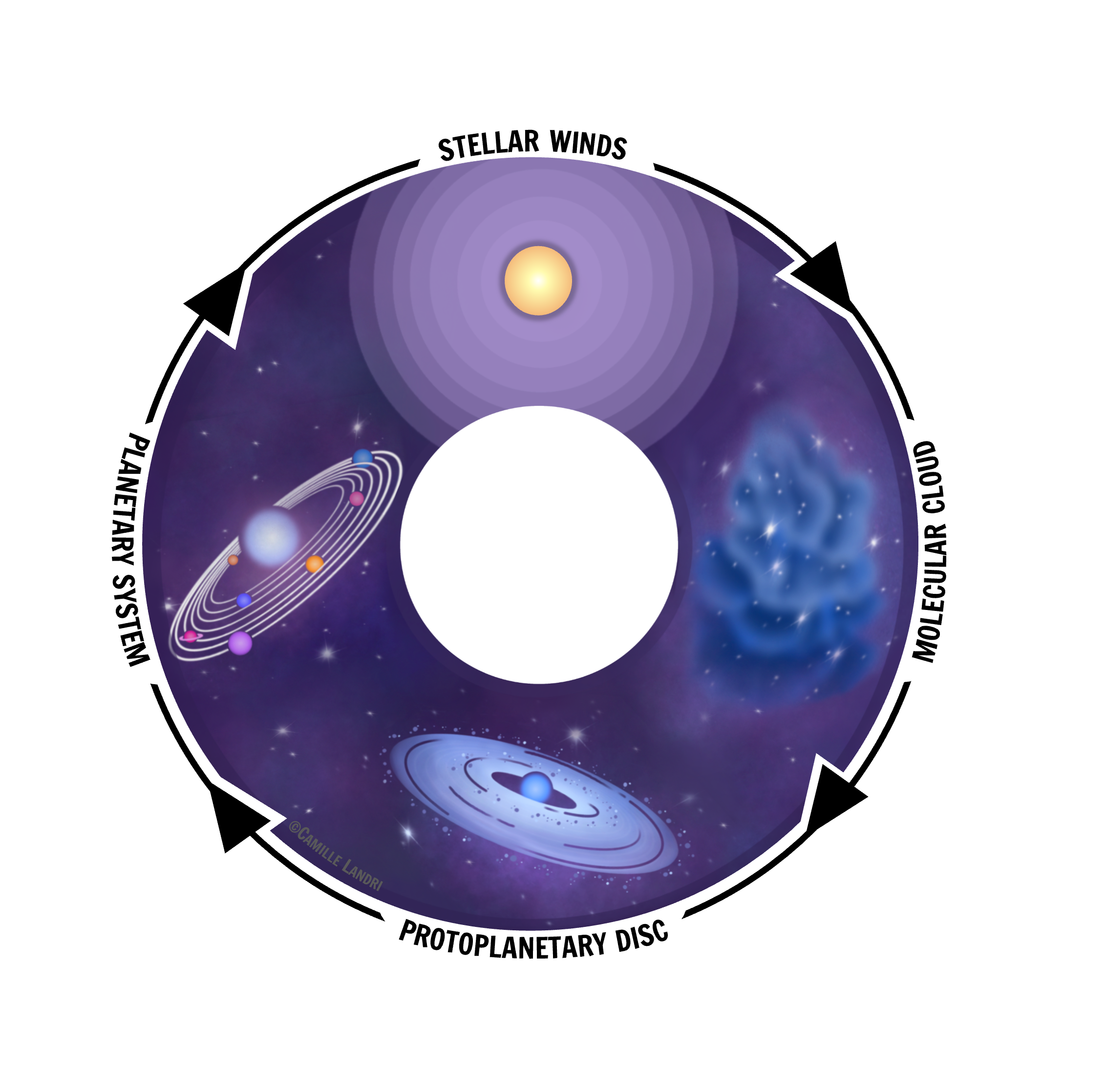
Lifecycle of stars. Stellar winds seed the interstellar medium, leading to the formation of molecular clouds.
These clouds then collapse into protostars, which accrete matter and later form of planetary systems.
-
AGB outflows
Close to their deaths, stars born with masses ranging from 0.5 to 8 times the mass of our Sun experience a phase of strong mass loss, an evolutionary stage commonly called the Assymptotic Giant Branch (AGB) phase. During this phase, a combination of pulsations and dust formation drives a stellar wind at the surface of the star, gradually stripping the star from its material, and causing a macroscopic outflow. In turn, this leads to the creation of a vast circumstellar envelope (CSE).
High resolution observations of these CSEs show that instead of being spherically symmetric, these outflows exhibit a variety of complex geometries, from spiral patterns (see image below), to disc-like structures or even random structures. These structures are thought to be due to a companion obejct orbiting the AGB star, which then interacts gravitationally with the wind and perturbs the ouflow.
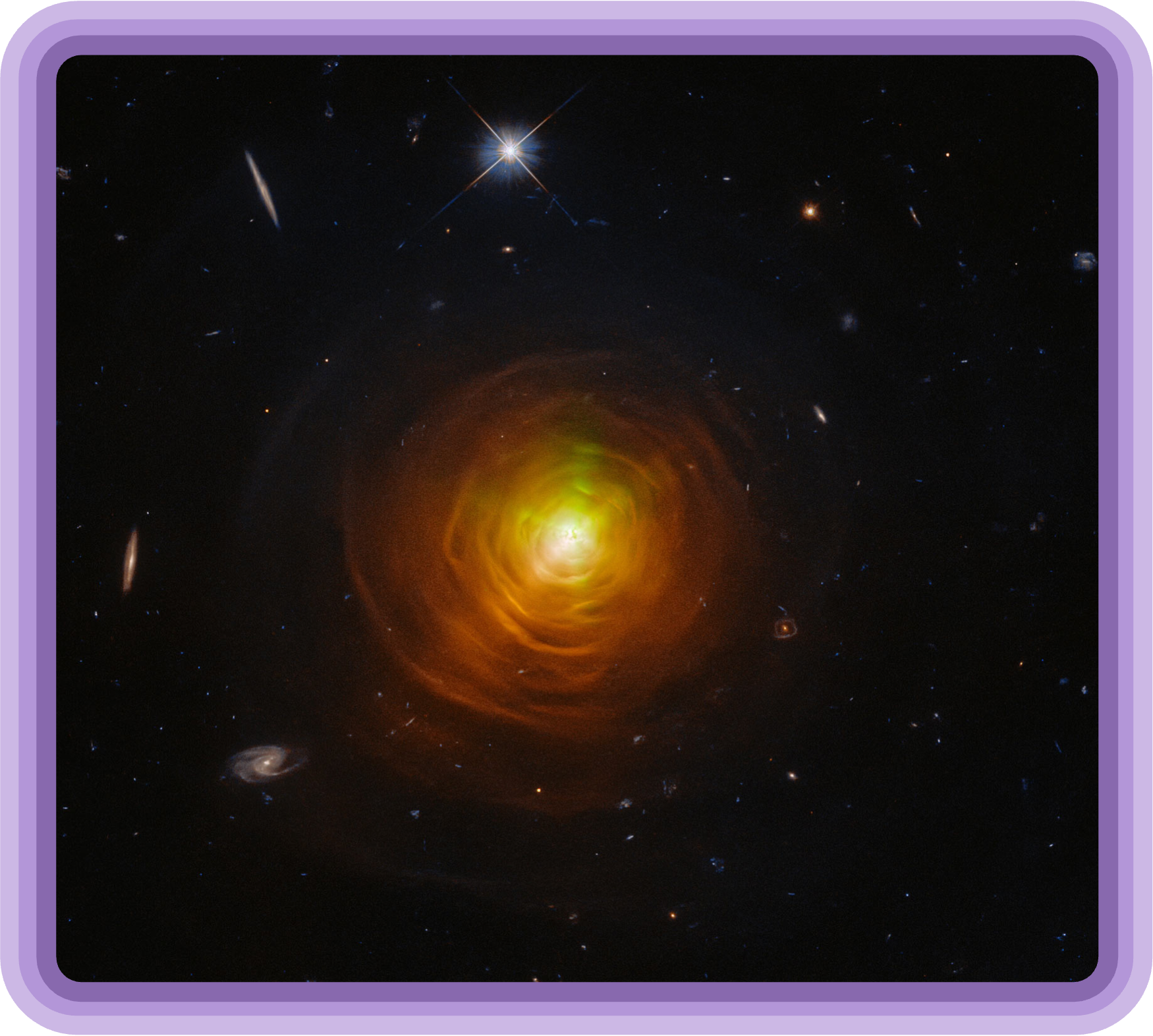
Hubble observation of the outflow around the AGB star CW Leonis (NASA/ESA).
Additionally, the CSE around AGB stars is exposed to UV radiations from the surrounding interstellar medium, which photodissociate the neutral species present in the outflow. The ions and radicals, created by the photodissociation, then allow for a rich chemical activity that forms a wide diversity of molecules. The formation of molecules depend on the physical state of the outflow, for instance the local densities, temperature and the radiation passing through the gas. Some molecules can form in denser regions of the outflow, while other may only form in the colder outer regions. Thus, observing the emission of specific molecules in AGB outflows is a crucial tool to understand better the dynamics and state of the outflow.
-