

Section outline
-
-
The code
MACE stands for machine learning approach to chemistry emulation. It is an architecture trained as a surrogate model for astrochemistry, and is able to reproduce the evolution of chemical abundances in about 5% of the time its classical analogue takes. It consists of an autoencoder (encoder + decoder), which maps the input space to a latent space with reduced dimensionality and vice versa, and a trainable ODE, that solves the evolution of the “latent chemistry” over time.

The encoder and decoder are represented by a neural network and have a mirrored architecture with respect to each other. The input, i.e. the physical parameters of the environment and set of initial chemical abundances, is first mapped to its latent representation by the encoder. This latent input is then evolved over a latent time, which is connected to the physical time, by the trained latent ODE. Finally, the evolved latent state is mapped back to the dimensions of the original input by the decoder.
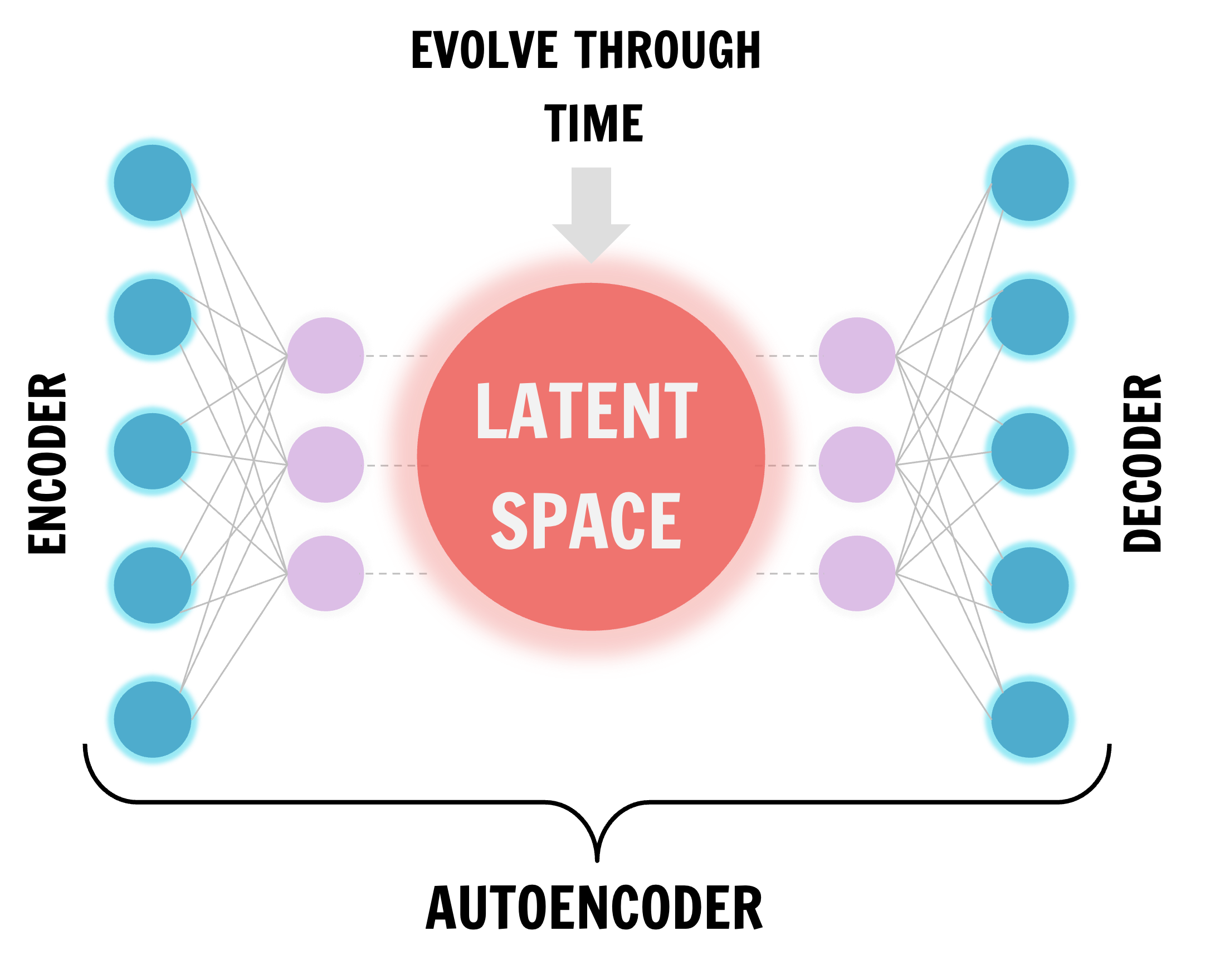
Architecture of MACE
-
Usage
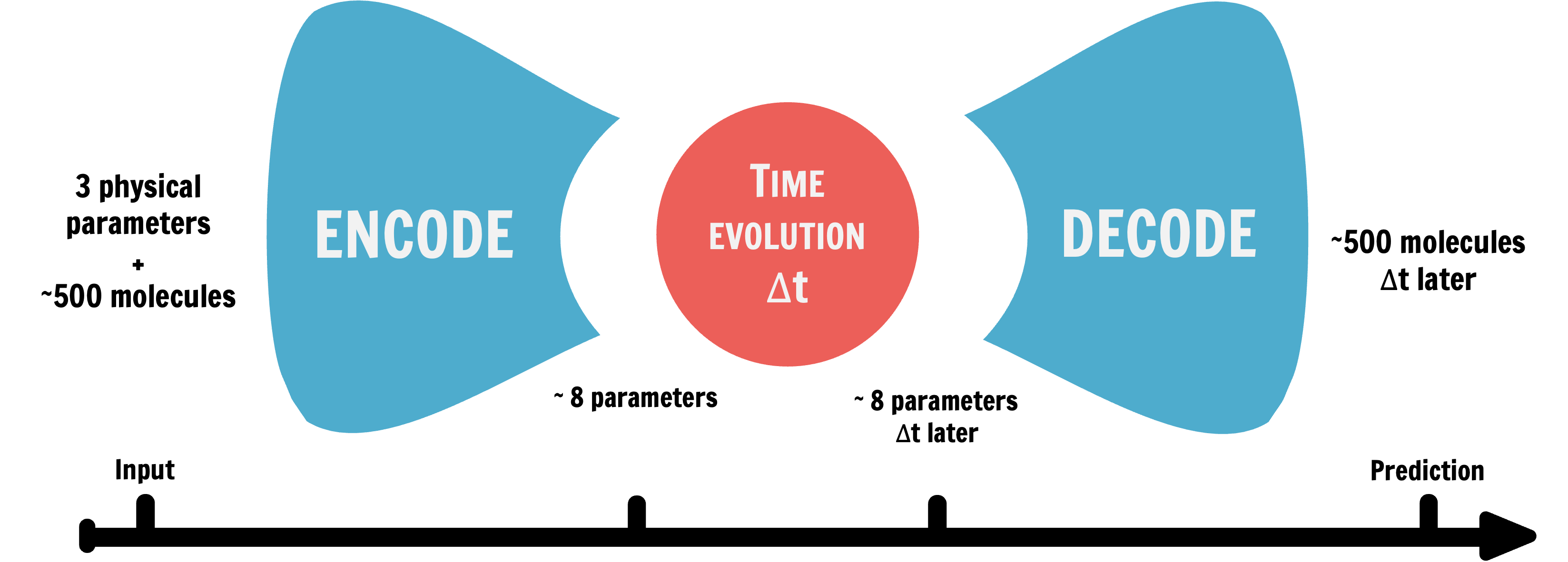
MACE acts as a 0D surrogate model for chemistry. This means that the input consists of the physical parameters at a certain time/location in the simulation and the time interval of chemical evolution, together with a set of abundances (n0). MACE returns the set of abundances at the later time interval (nt).
-
More on MACE
For more information on how we built MACE, watch this video!
-