

Section outline
-
-
Why simulations?
Experiments in astrophysics are limited. Since we are incapable of reproducing stars or galaxies in a lab, we rely mostly on observations and simulations to test out theories. Specifically, we set up theoretical models of astrophysical environments starting from the basic laws of physics, and compare the results with observations. We can then refine the models by adding more physical processes, or expand the initial conditions to explore a larger parameter space.
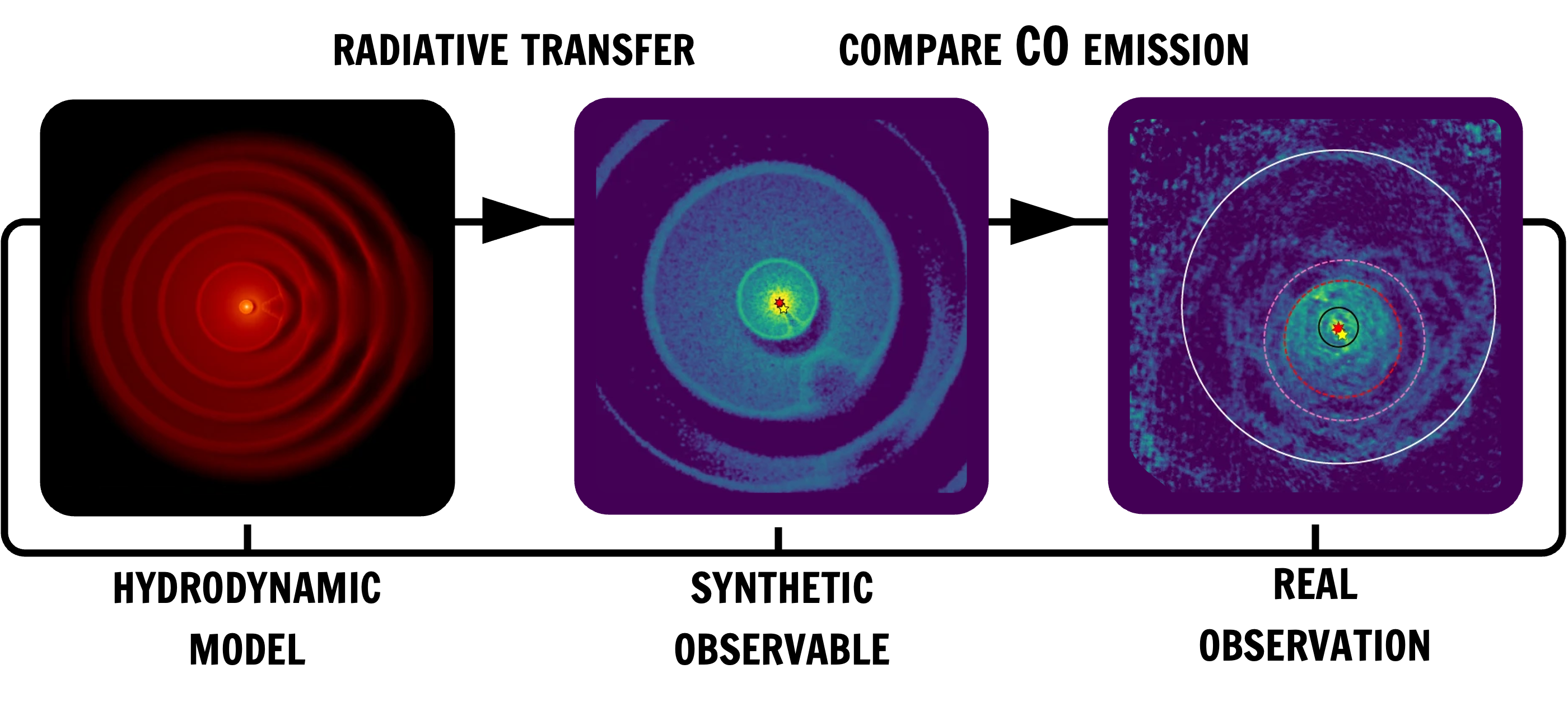
Starting from hydrodynamic model, we run radiative transfer with some assumption on chemical
abundances and obtain a spectrum, then compare this synthetic spectrum with real observations.
For environments where the interplay between chemical and physical processes is strong, such as AGB outflows, the complete astrophysical model should consist of a minimum of three building blocks. We need (i) hydrodynamics, to describe the dynamical processes of the astrophysical fluid, (ii) radiative transfer, to describe the interaction between the light and fluid, and (iii) chemistry. Ideally, these three building blocks should be incorporated into a 3D model, capable of resolving the spatial complexity of the environment.
-
Coupling chemistry and hydrodynamics
While the ideal astrophysical simulation may include hydrodynamics, radiative transfer and chemistry, issues quickly arise when considering the computational cost of each component. Hydrodynamics and radiative transfer are already computationally intensive, but incorporating chemical kinetic networks immensely increases both the memory and computational cost of the model.
When studying chemical kinetic networks, we need to solve a large number of coupled ordinary differential equations (ODEs). Since chemical reaction rates span many orders of magnitude and certain chemical processes have very short timescales, the ODEs are very stiff and should be solved over very small time steps to ensure the stability of the solutions. And naturally, the more extensive and accurate the network, the more expensive the calculation, since it should account for hundreds of chemical species which are connected by thousands of reactions. Fortunately, such a calculation takes only a fraction of a second. However, solving the set of coupled ODEs at every time step, at every position in a 3D simulation, quickly escalates to a huge amount of added calculation time to the already computationally expensive model. This renders these complete models impossibly expensive, especially if one wants to explore a reasonable part of the parameter space of the astrophysical environment we are interested in.
We thus need to be creative with finding new techniques to speed up the simulations. Different approaches have been investigated over the past decades, and the most popular ones aim to reduce the chemical network to its key species and reactions, given the environment. However, such methods require extensive parameter studies and error quantification to assess the reduced network’s performance. More importantly, by using a reduced network one runs the risk of neglecting species and/or reactions that contain vital yet unforeseen information on the physical state of the environment. Therefore, it is important to keep a full chemical network to retain a certain level of accuracy. In this specific case, we aim to incorporate a full chemical network and turn to techniques of machine learning (ML) in order to a surrogate model for astrochemistry.
-
More on astrochemical simulations
For a more detailed explanation of the complexity of astrochemical simulations, check out this video!
-