
-
The transit method
Most known exoplanets were found by the transit method. When a planet passes in front of its star it blocks a little of the starlight, producing a brief, periodic dip in the star’s brightness over time, its light curve. Because one space telescope can monitor hundreds of thousands of stars at once, the method scales well: Kepler and TESS have used it to find thousands of planets, and the European Space Agency’s PLATO mission, planned for launch in 2027, will take it further. A planet crossing its star produces a dip in the light curve.
-
A small signal in a lot of data
PLATO’s main targets are small, rocky planets around Sun-like stars. An Earth-like planet dims a Sun-like star by only about 100 parts per million, a signal easily hidden by stellar variability and measurement noise; even for PLATO’s best targets, several transits are needed for a confident detection. Stellar variability is usually removed first by detrending the light curve, and CETRA is designed to work on detrended data. PLATO will also produce long light curves at high cadence, observing some stars every 25 seconds for at least two years. The current state-of-the-art search, Transit Least Squares (TLS), takes around 2 CPU core-hours for one two-year light curve at 600-second cadence, and about 50 times longer at 25 seconds. Across hundreds of thousands of stars, that is a major computational challenge, and the one CETRA was built to solve.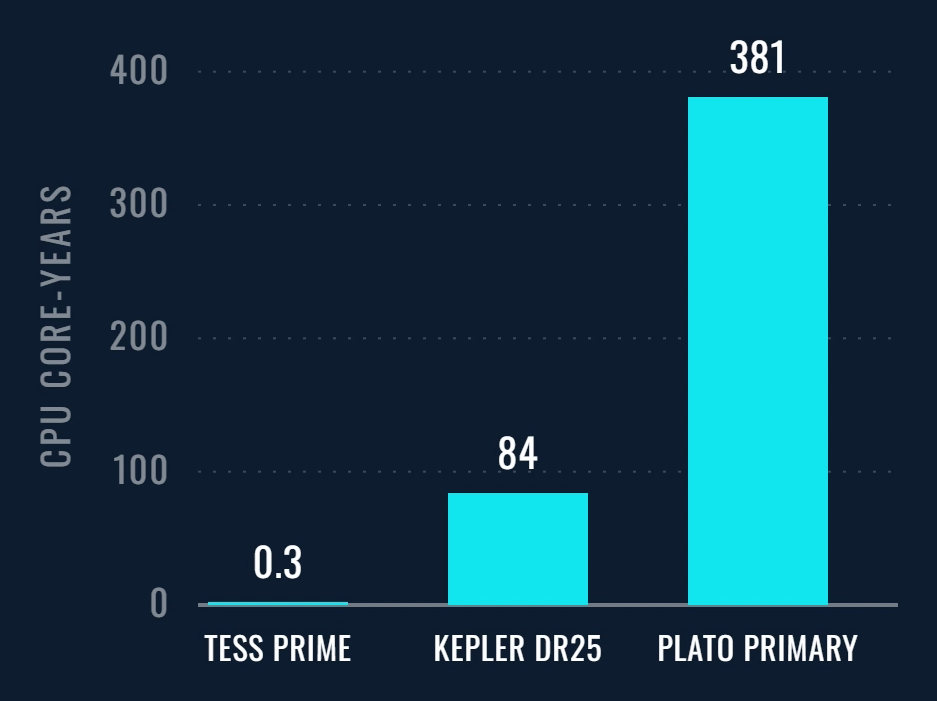 Estimated CPU core-years to run Transit Least Squares on each mission’s data.
-
BLS and TLS
Box-fitting Least Squares (BLS), published in 2002, phase-folds the light curve over a grid of trial periods and fits a box-shaped dip. TLS, published in 2019, replaced the box with a realistic transit shape and smarter search grids, improving sensitivity to small planets. CETRA borrows heavily from TLS, but at PLATO’s scale TLS has limits: its computational cost, how gaps in the data distort the phase-folded light curve, and a coarser effective step in transit time for long-period planets, exactly the planets PLATO is most interested in.
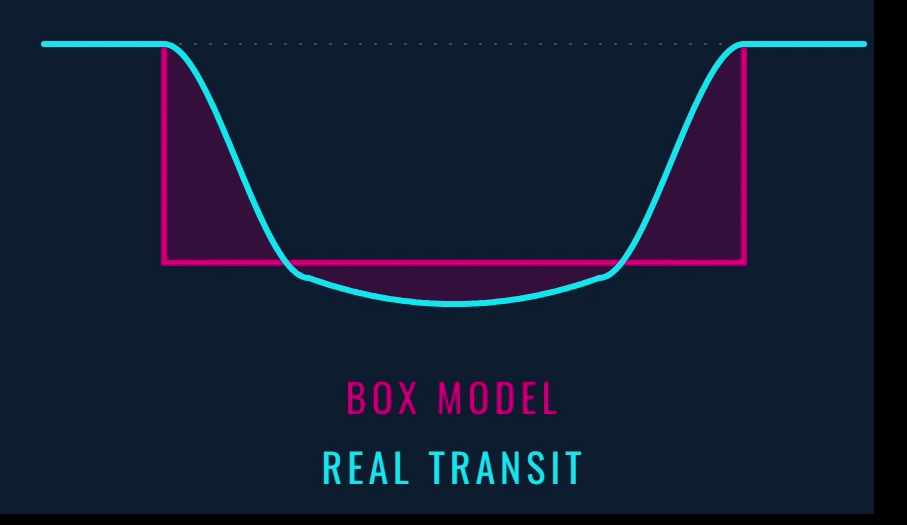 A box model (magenta) compared with a real transit shape (cyan).
