
-
Search first, fold later
CETRA reverses the usual order. BLS and TLS phase-fold the light curve first and then search it; CETRA first runs a linear search along the light curve in time, then phase-folds the compact results over trial periods. This avoids sorting entirely and, because every moment in time is tested independently of any period, it also detects single transits, or monotransits, for free.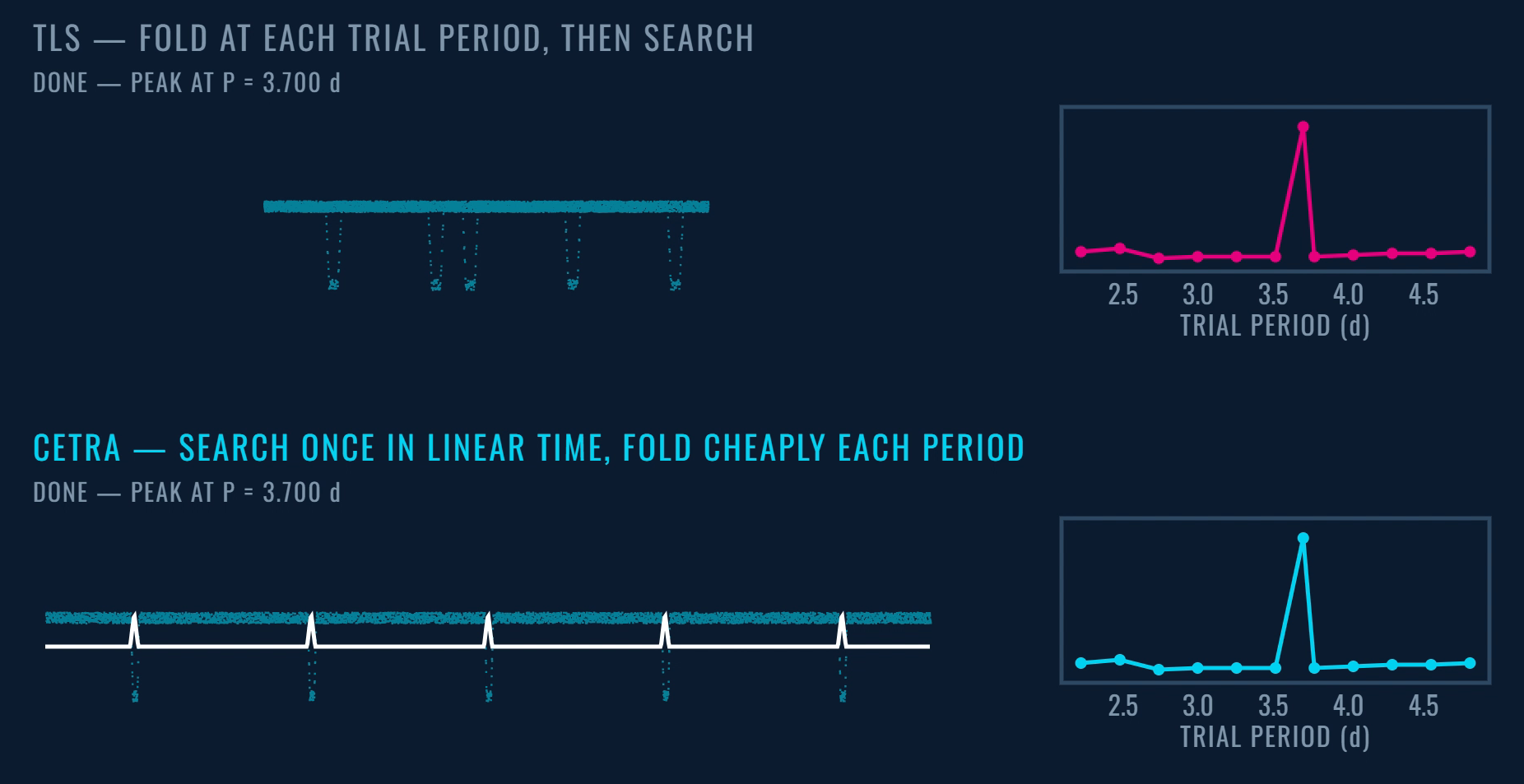 TLS folds at every trial period, then searches; CETRA searches once in time, then folds the results.
-
Built for speed
Before searching, CETRA resamples the light curve onto a regular time grid. Observations on the same grid point are combined with an inverse-variance weighted mean, and empty points get infinite uncertainty, so they contribute nothing. Finding the data inside any transit window then becomes simple index arithmetic, and gaps are handled formally.
Two further optimisations made a large difference. Holding the transit model, a short array, in fast shared memory roughly halved the search kernel’s run time. Switching to 32-bit precision cut the run time by a factor of three on a desktop GPU; storing flux and time as offsets from their baseline values keeps the precision needed for signals of 100 parts per million.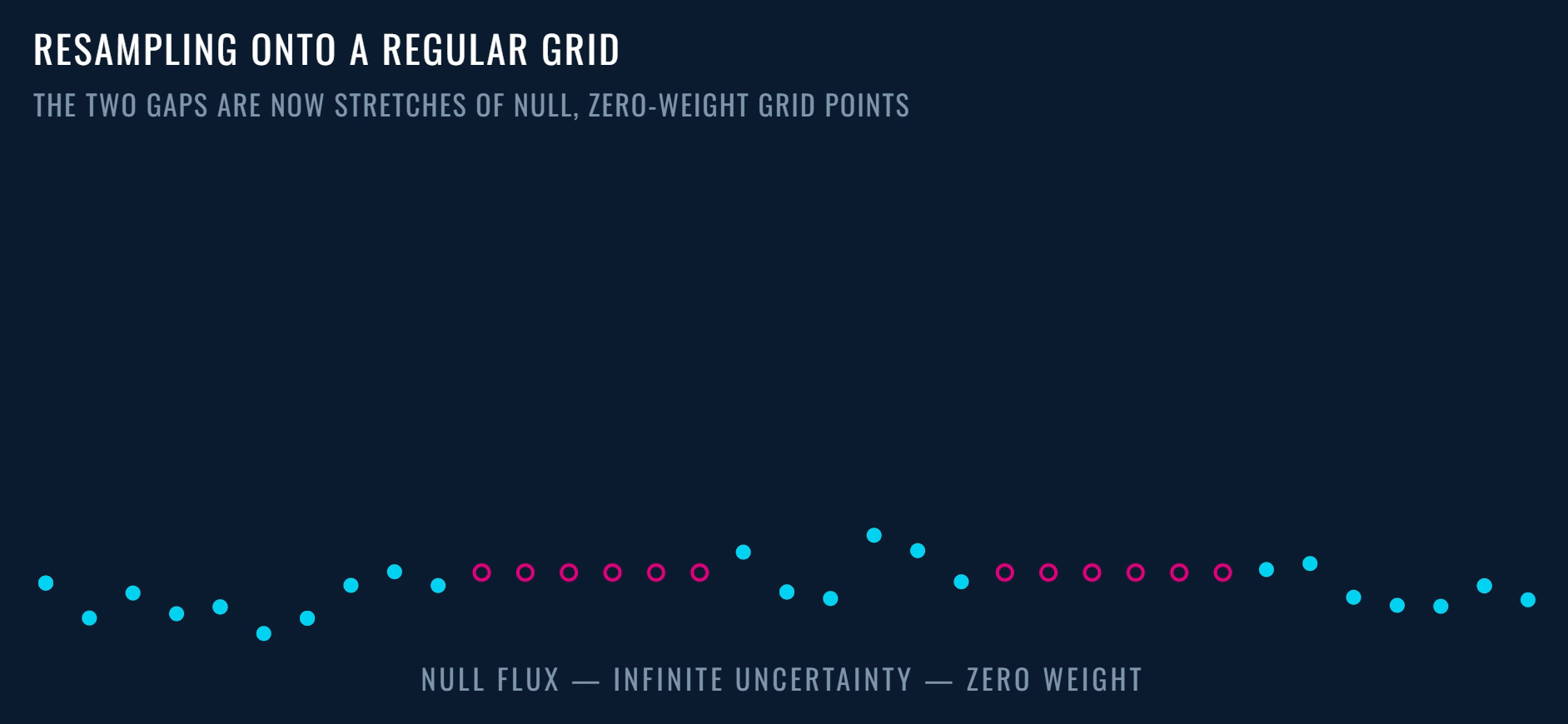 After resampling, data gaps become null grid points that carry no weight.
-
Two GPU kernels
The linear search sweeps a grid of transit times and durations. Because the light curve is stored as offsets from its baseline, the likelihood ratio between “transit” and “no transit” depends only on the points inside the transit window, so each evaluation is cheap. Its outputs, arrays of depth, depth variance and likelihood ratio, stay on the GPU. The periodic search then combines them for each trial period, using the same period and duration grids as TLS, and returns only the best result for each period: a periodogram in which a clear peak marks a detected planet.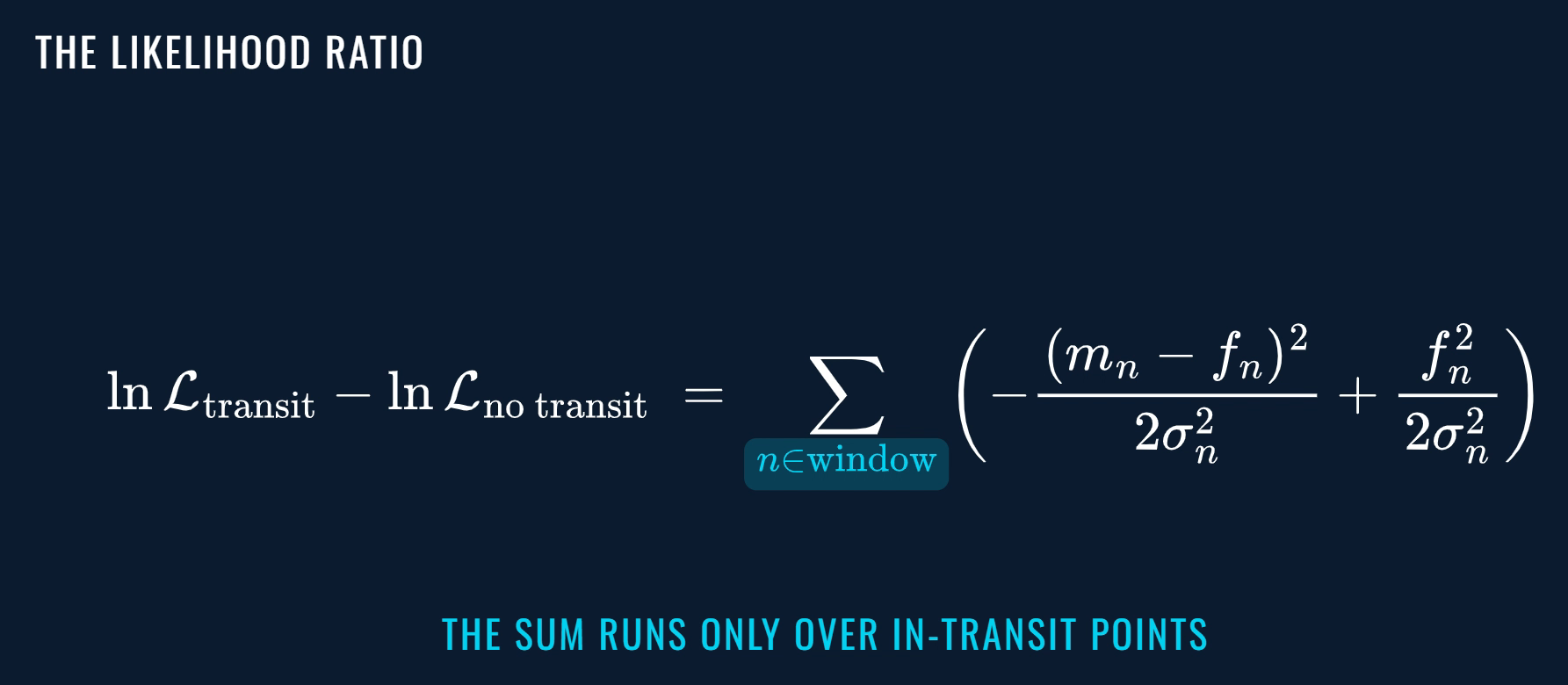 The likelihood ratio, where f is the observed flux, m the model flux and σ the uncertainty: only points inside the transit window contribute.
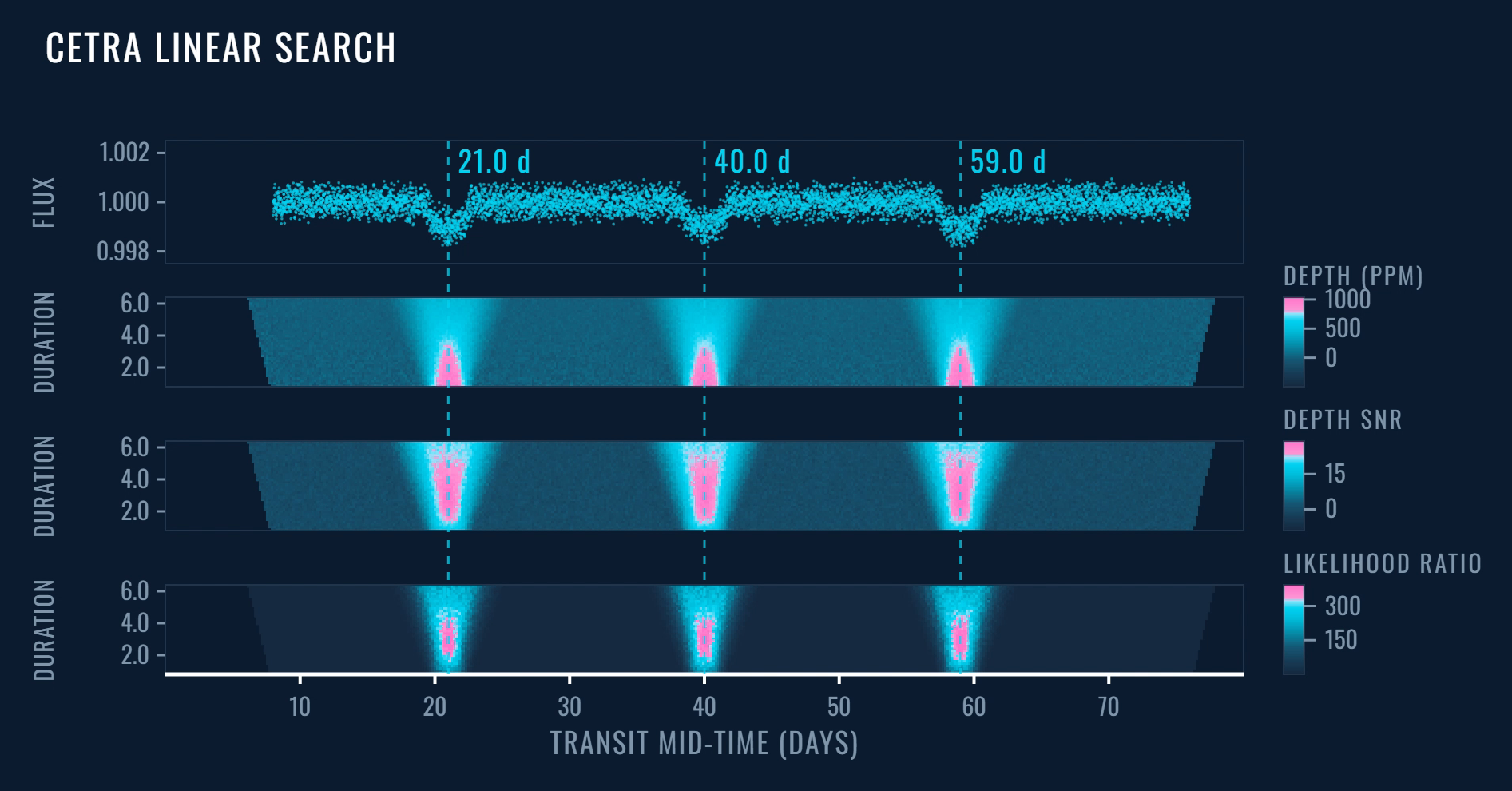 Linear search output: depth, depth signal-to-noise and likelihood ratio for every transit time and duration.
